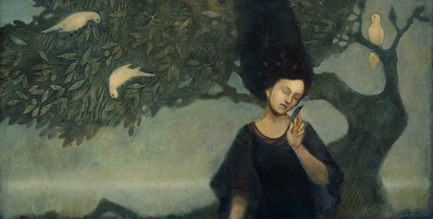
Here's another I've been working on for Browns and Rusts. I'm wondering how the imagery holds together (if at all) and if the language is crisp enough. And I'm posting it because, well, I need some feedback, which, as always, is completely welcome.
* * * *
I once found religion at the dollar store:
(On Olive Leaf)
the Word wrapped in cellophane ripped
on the binding side where the price tag
should have been, top-shelved beside
glossy atlases full of trips my daughters
have taken across the in-laws’ living room
floor, roving Grandpa’s hardbound book
of oversized maps with an eight-by-ten
lens that makes an omniscient eye, hills
wave, the oceans and rivers climb the banks
of their innocence; beside pocket planners
and a pack of Wrigley’s the clerk will have to
re-stock on an impulse tier because someone
changed minds, chose the two-for-a-dollar
nut rolls instead, let the chewing gum lie
a half-aisle down.
And again on a morning run up Galbraith Hill:
the rise and fall, longer rise and fall of body
against wind, flesh pressed into silence like
the New Zealand fern leaf I flattened
into my KJV and smuggled past customs
into the canon of memory; have climbed like
Eve Adam’s ribs, Jacob angel flesh, Christ
Israel’s barbed history, my soul rubbed thin
on the altitude, God at my heels, the crickets
gone dumb in the thrum of his entourage,
the meadows ablaze with their sigh.
And now in Noachian blue: in the swell
of these doves ripe as Eden in fall, as this Eve
whose flesh gathers amniotic sky, the deluge
receding in purl and girth of fabric, wind, and
limb bent beneath atmospheres of God; in
the ribs of the leaf she reads with her fingertips
like a roadmap to peace, feeling for the pulse
of this tree Adam planted the night they
buried Abel, watched Cain retreat into dusk,
his footfalls marring the field the two had
haunted as boys, laughter spilling through harvest
like his brother’s blood the moment he pulled
the blade, heard Lucifer’s laugh in the gash,
and turned to wipe his hands on the flock come
to drink from the river of God’s sudden tears.
Thursday, July 30, 2009


Tuesday, July 28, 2009
Monday, July 27, 2009
Double-dipping at AMV
So sue me. Then come join the conversation that started here first over there.
On Potty Training, Tooth Fairies, and Hunting Ducks
 Since my last post on this topic a month ago, I'm happy to report that we've only had a limited amount of sans potty water making (I think I can count the incidents on one hand, though I'm still knocking on wood. Hear that?) and she's been doing excellent at night: we still put a pull-up on her, you know, just in case, but she wakes up with it dry every morning.
Now if only we could convince her there are no tiny monsters living on or near the lamp in their bedroom (don't know where that idea came from) maybe she'd sleep through the night and we'd have fewer things to keep us up at night.
 On a similar note, Number One had a repeat night visitor a couple of weeks ago when she lost her first two teeth, the second just days after the first. The first night she said she felt T.F. walk across her pillow and trade the tooth for moolah. Luckily, she didn't wake up because, well, she may have discovered that T.F. is a bit bigger than she expects and doesn't really look like this pic. Oh and that, in this case, she isn't exactly a she.
 And on a final note: Number Three's taken to hunting ducks---of the Usborne kind, that is. Grandma gave them all The Usborne Book of Fairy Tales and she discovered the joy of the hunt. I think she could spend hours turning the pages, pointing to hidden water fowl, yelling, "Mom! Ducky!" Who says kids don't have much of an attention span?
Ah, the endless wonders of toilets, teeth, and ducks.
Friday, July 24, 2009
Linda Sillitoe: "Encounter"
One of the most striking poems I've read recently is Linda Sillitoe's unrhymed sonnet "Encounter" (from Dialogue 35.1 [2002]), which takes as its lyric province the intergenerational relationship between people, places, and possessions (yes, the alliteration was on purpose). The poet, born of goodly parents (at least it seems so from the cache of memories stirred in this sensory experience), begins by lyrically binding the three and expanding and deepening the connections from there.
Notice in particular the alliteration at work as binding agent in the first five lines (as through the entire poem): the /n/'s, the sister sounds /b/ and /p/, /d/ and /t/, the /s/'s, the /g/'s, all grouped variously throughout, then combined in the last clause of line five: "I glanced behind me." I read this mixture as the lyric medicine the poet found in this cabinet of wonders (even though she claims she was just looking for a comb): as she turns toward her past, toward (I presume) her father's presence in the room, in her life, she finds a genie-like granting of the wish smoldering beneath the surface of the poem---that she could remember her father, "[t]wo years" gone, but always a defining presence in her being and in her connection to her mother and to the past (and thus to her present and future).
This desire surfaces---and ripples through subsequent readings of the poem---in the last three lines, the denouement in which the poet wonders about her mother and, beyond that, about the fusion of time and person, place, thing, and sense as this union moves to draw lucid experience, even ecstasy (as suggested by the narcotic-effect the sudden encounter has on the poet: "The room wavered like my knees" [line 6]), from memory's cistern and to immerse us in melancholy wonder over the duration, strength, and will of human connection.
Such is an appropriate sentiment to keep in mind, I think, as we strive to "summon" (12) presence and experience from kith and kin past to help and heal us in our present and our future relationships with person, place, and thing.
Notice in particular the alliteration at work as binding agent in the first five lines (as through the entire poem): the /n/'s, the sister sounds /b/ and /p/, /d/ and /t/, the /s/'s, the /g/'s, all grouped variously throughout, then combined in the last clause of line five: "I glanced behind me." I read this mixture as the lyric medicine the poet found in this cabinet of wonders (even though she claims she was just looking for a comb): as she turns toward her past, toward (I presume) her father's presence in the room, in her life, she finds a genie-like granting of the wish smoldering beneath the surface of the poem---that she could remember her father, "[t]wo years" gone, but always a defining presence in her being and in her connection to her mother and to the past (and thus to her present and future).
This desire surfaces---and ripples through subsequent readings of the poem---in the last three lines, the denouement in which the poet wonders about her mother and, beyond that, about the fusion of time and person, place, thing, and sense as this union moves to draw lucid experience, even ecstasy (as suggested by the narcotic-effect the sudden encounter has on the poet: "The room wavered like my knees" [line 6]), from memory's cistern and to immerse us in melancholy wonder over the duration, strength, and will of human connection.
Such is an appropriate sentiment to keep in mind, I think, as we strive to "summon" (12) presence and experience from kith and kin past to help and heal us in our present and our future relationships with person, place, and thing.
Wednesday, July 22, 2009
"Sorry, but you're looking for something that isn't here."
And my world was a little dimmer this morning because of what wasn't there.
In the midst of the joy I've found lately in rhetorical communion with cyber-friends old and new, the dark side of language came to play, stifling, though just for a moment, one of the bright spots in my reader. After a dear and insightful new friend exposed herself the other day by sharing the struggles she's had raising an autistic child in a world that refuses to understand, as Luisa notes, "At least two separate gangs of roving bullies discovered my friend’s post and publicly ripped it apart in open forums. They called my friend and her child obscene names and ridiculed both her faith and her parenting." As if that wasn't bad enough, some people emailed her, basically told her she and her son weren't worthy of being called "human," of propagating the race.
And now I realize how little tolerance I have for people who prey on the meek and perpetuate prejudice and violence through the rhetoric of hate, something that Brillig has now answered with compassion. (Bravo Brillig!)
As I become more sensitive to the nuances of language and the needs of the various audiences I associate with, I realize how powerful words are as a means of compassion, communion, and healing; also as means to cultural/personal destruction, alienation, and pain. In a world rife with the latter, I committed long ago to use my language for the former, to learn the healer's way with words so I might reach out and somehow soothe the afflicted soul. Such, I'm convinced, is a way to lasting personal and cultural peace: to take responsibility for what our words might do once we've sent them into the world and to shape them accordingly; to cultivate an awareness of how our presence, our compassion can and must influence the world, of how we can fully occupy the space where our lives touch other lives, where a look or a touch of the hand or the simple act of listening or a string of carefully chosen or inspired words can spark new associations within and between selves. And this means knowing, among other things, that we can create new intra- and interpersonal worlds based on the responsible and responsive use of language.
And so I'm struggling today to offer something of hope to my down-trodden friend. To lift the hands that hang down and strengthen the feeble knees (ref). To publish peace by recommitting myself to learn the names of all the vital things, to wield carefully and with respect and compassion the life-shaping power of words.
I know it's not much, but I hope that, somehow, it might just be enough to make a difference. Somehow.
In the midst of the joy I've found lately in rhetorical communion with cyber-friends old and new, the dark side of language came to play, stifling, though just for a moment, one of the bright spots in my reader. After a dear and insightful new friend exposed herself the other day by sharing the struggles she's had raising an autistic child in a world that refuses to understand, as Luisa notes, "At least two separate gangs of roving bullies discovered my friend’s post and publicly ripped it apart in open forums. They called my friend and her child obscene names and ridiculed both her faith and her parenting." As if that wasn't bad enough, some people emailed her, basically told her she and her son weren't worthy of being called "human," of propagating the race.
And now I realize how little tolerance I have for people who prey on the meek and perpetuate prejudice and violence through the rhetoric of hate, something that Brillig has now answered with compassion. (Bravo Brillig!)
As I become more sensitive to the nuances of language and the needs of the various audiences I associate with, I realize how powerful words are as a means of compassion, communion, and healing; also as means to cultural/personal destruction, alienation, and pain. In a world rife with the latter, I committed long ago to use my language for the former, to learn the healer's way with words so I might reach out and somehow soothe the afflicted soul. Such, I'm convinced, is a way to lasting personal and cultural peace: to take responsibility for what our words might do once we've sent them into the world and to shape them accordingly; to cultivate an awareness of how our presence, our compassion can and must influence the world, of how we can fully occupy the space where our lives touch other lives, where a look or a touch of the hand or the simple act of listening or a string of carefully chosen or inspired words can spark new associations within and between selves. And this means knowing, among other things, that we can create new intra- and interpersonal worlds based on the responsible and responsive use of language.
And so I'm struggling today to offer something of hope to my down-trodden friend. To lift the hands that hang down and strengthen the feeble knees (ref). To publish peace by recommitting myself to learn the names of all the vital things, to wield carefully and with respect and compassion the life-shaping power of words.
I know it's not much, but I hope that, somehow, it might just be enough to make a difference. Somehow.
Chasing Geese at WIZ
My reprise to Leslie Norris' beautiful poem "Hudson's Geese" is showing at Wilderness Interface Zone today. Come check it out. All the cool kids are, er, at least they might be.
Tuesday, July 21, 2009
"Days When Nothing Happens"
 Laying on the living room floor this afternoon as daughters one and two built a fort out of the coffee table and blankets and as number three fell asleep on my chest, this poem came to mind. Since I can't find it anywhere on the web, I can't link to it, so I'll just post an excerpt in hopes that I'm not breaking any copyright laws.
Happy reading about, well, a whole lotta nuthin'.
* * * *
Days When Nothing Happens
by David Tucker
(from Days When Nothing Happens [Slapering Hol Press, 2004])
On days when nothing happens
a jet loafs overhead, an hourglass of smoke
fanning out behind it.
On days when nothing happens
a paper sack plays in the street, your overcoat hangs
and forgets you[,]
[...]
the mantel clock calls
the small noises back to the house,
a daughter's red sneaker
sits all afternoon on the window sill,
trying to be quiet.
Monday, July 20, 2009
This Svithe Brought To You By Eugene England
It's been a bit since I've svithed outright, though I've been including spiritual matters weekly (and, perhaps, weakly), so I guess that counts (if anyone, beside the blogging gods, is really counting). This week's is brought to you by way of Theric, whose special guest svithe from David O. McKay reminded me of England's popular essay "Why the Church is as True as the Gospel" in which he relates the same David O. story, and which I've been thinking about since. As I reread the essay last night (I just got England's essay collection of the same title in the mail last Friday), this paragraph especially struck me, especially as I try to perform my elders' quorum secretarying (an imposition, for sure) to the best of my ability:
I think that's one reason (among others) I stick around---because, despite my misgivings with some people and how some things are administered and taken for granted or not considered too deeply in the Church, my covenant relationship with the Church itself forces me beyond self-interest and, in the process (and England's words), "gives [... me] a chance to be made better than [... I] might choose to be, but ultimately need and want to be." And I think that's how God intended things.
At least that's what I choose to believe. And it doesn't hurt to believe too much, does it?
I know God has been found by unusual people in unusual places---in a sudden vision in a grove or orchard or grotto, or on a mountain or in a closet, or through saintly service to African lepers or to Calcutta untouchables. But for most of us, most of the time, I am convinced he can be found most surely in "the natural sequence to the performance" of the duties he has given us that all of us (not just the unusual) can perform in our own homes and neighborhoods and that the Church, in its unique community, imposed as well as chosen, can best teach and empower us to perform. (Also found here.)As I get my hands dirty, so to speak, in the nitty gritties of quorum administration and my faltering attempts at personal ministry, I am taught about how I can best meet others' needs (including my family's) and empowered in my feeble efforts. And I sense how much God cares about those I brush shoulders with. And I become, I think---I hope---a bit more compassionate and charitable.
I think that's one reason (among others) I stick around---because, despite my misgivings with some people and how some things are administered and taken for granted or not considered too deeply in the Church, my covenant relationship with the Church itself forces me beyond self-interest and, in the process (and England's words), "gives [... me] a chance to be made better than [... I] might choose to be, but ultimately need and want to be." And I think that's how God intended things.
At least that's what I choose to believe. And it doesn't hurt to believe too much, does it?
Thursday, July 16, 2009
Triptych for My Twenty-Third Year (Poem)
Today our oldest turns six. Not only has she lost her first two teeth in the past week, but she's made a significant difference in the course of my life and mind. (Random connection, that, isn't it?) I've tried to capture something of that course in this poem, which I hope is just personal and particular enough to be universal. You'll have to let me know if it works and, if it doesn't, why.
So, first, even though I know she doesn't read my blog, happy birthday, Sid.
And second, here's the poem (part of my meditations on J. Kirk Richards; though there's nothing really grand about the painting, for some reason, perhaps the connections I made because of the title, it inspired this longish response):
Triptych for My Twenty-Third Year: Three Views of Self-portrait at 23
View I (After Eliot)
He’s all oil and pigment lies,
truth washed from his flesh
into shallow blue iris pools,
brimful basins
that crest the infant slit of his face
into a garden he’s never tended
near the house he’ll never own
down a passage he’s never walked
into a room he’ll never leave. I
wait for him at the water’s parting heads
as Adam may have waited
for the serpent to cool its tongue
in Eden’s quartered stream, wait
for the lies to add up some truth
about oil and pigment, brushstrokes,
me, and my twenty-third year when,
holding my minutes-old daughter, I
fell into the basin of her soul, tripped,
face first, into an afterbirth lined font,
heard, from the crimson milieu of the womb:
Quick, said the serpent, find him, find him.
Around the corner. Through the first gate.
Into our first world. Follow
the deception of the thrush.
View II: Four Variations on View I
i
Waterfowl ripple the artist’s eyes like cherubim folding the earth,
restraining the torrent of God’s tears until Noah’s vessel was tight
as a womb, ready to break water, bear an Infant suckled eons on
the serpent’s cured ribs.
Or like the dove’s pulse unfolding peace
as it pierced the channeled firmament, bearing Adam’s unearthed
rib with marrow enough still to help Noah and Co. revise
God’s genome for posterity.
ii
God bathes in the light streaming down the right side of the artist’s
face, rides it like a family on innertubes coasting down the Snake’s
backside, the river’s skin tight across ribs that ripple as the moon
eddies sky, as wind plays through the corridor, ruffling scales
of light across the eddied plane. I watch them glide to the bank,
help them ashore, offer a towel to wipe the brazen oil from their
Solitude.
iii
Silence throbs through the artist’s half-pictured brush: an umbilical
snipped when he stepped from himself, rinsed the body’s afterbirth,
stretched it on rosewood ribs, hung it to dry before he primed
the surface, started painting again. His strokes sear the womb like
sound unearthing bone beneath my oil and pigment skin: an I cradling
a six-pound newborn girl suckled for eons on God’s teat, her and I face-
to-wave with an amniotic eternity.
iv. Sidney at Two Months
Her legs’ cadence draws me from dream. I slip into dawn’s chill to
warm her back to sleep, slicing shadow with the hallway’s
incandescent light. I crack her door, carve a sliver through her room,
bathe in the infant slit of her deep blue iris pools like when I stood
at her mother’s feet, saw the sliver of her crimson crown push through
before her first breath pierced my ribs and set my pulse to the rhythms
of her life.
View III: Logan, Utah, 2003
The year God yanked me from
sculpture class with a hand-scribbled
note with no signature:
Dear Sir/Madam:
Tyler is indefinitely excused
from the plastic arts.
Not quite like days off for 9/11
or snow, my oldest sister’s wedding
or Grandma’s brother’s funeral
(where we sang “The Beer Barrel Polka”
over his freshly coffered flesh),
but a revelation still
once I recognized desire in the space
where God’s autograph should have been
and signed the emptiness myself,
looping my ‘T’ like the mid-air flip
of rose hips knocked loose by a breeze.
Like the serpent’s perpetual tongue.
Like a robin’s breast proud against
dawn. Like the sonorous curve
of Sidney’s mouth pressed for the first time
against her mother’s breast. Like
this eddied composition, paint waves
furrowing language and memory,
gray matter set ablaze in the flame
of these ten thousand strokes
set in motion as I walk Eden’s corridors
in the cool of day trying to remember the song
Adam sang to Eve the night she broke water,
pressed a world from her womb, and, as she slept
a mother’s fitful sleep, left
swirling canyons of words through
the crimson silhouette of my dreams.
So, first, even though I know she doesn't read my blog, happy birthday, Sid.
And second, here's the poem (part of my meditations on J. Kirk Richards; though there's nothing really grand about the painting, for some reason, perhaps the connections I made because of the title, it inspired this longish response):
Triptych for My Twenty-Third Year: Three Views of Self-portrait at 23
View I (After Eliot)
He’s all oil and pigment lies,
truth washed from his flesh
into shallow blue iris pools,
brimful basins
that crest the infant slit of his face
into a garden he’s never tended
near the house he’ll never own
down a passage he’s never walked
into a room he’ll never leave. I
wait for him at the water’s parting heads
as Adam may have waited
for the serpent to cool its tongue
in Eden’s quartered stream, wait
for the lies to add up some truth
about oil and pigment, brushstrokes,
me, and my twenty-third year when,
holding my minutes-old daughter, I
fell into the basin of her soul, tripped,
face first, into an afterbirth lined font,
heard, from the crimson milieu of the womb:
Quick, said the serpent, find him, find him.
Around the corner. Through the first gate.
Into our first world. Follow
the deception of the thrush.
View II: Four Variations on View I
i
Waterfowl ripple the artist’s eyes like cherubim folding the earth,
restraining the torrent of God’s tears until Noah’s vessel was tight
as a womb, ready to break water, bear an Infant suckled eons on
the serpent’s cured ribs.
Or like the dove’s pulse unfolding peace
as it pierced the channeled firmament, bearing Adam’s unearthed
rib with marrow enough still to help Noah and Co. revise
God’s genome for posterity.
ii
God bathes in the light streaming down the right side of the artist’s
face, rides it like a family on innertubes coasting down the Snake’s
backside, the river’s skin tight across ribs that ripple as the moon
eddies sky, as wind plays through the corridor, ruffling scales
of light across the eddied plane. I watch them glide to the bank,
help them ashore, offer a towel to wipe the brazen oil from their
Solitude.
iii
Silence throbs through the artist’s half-pictured brush: an umbilical
snipped when he stepped from himself, rinsed the body’s afterbirth,
stretched it on rosewood ribs, hung it to dry before he primed
the surface, started painting again. His strokes sear the womb like
sound unearthing bone beneath my oil and pigment skin: an I cradling
a six-pound newborn girl suckled for eons on God’s teat, her and I face-
to-wave with an amniotic eternity.
iv. Sidney at Two Months
Her legs’ cadence draws me from dream. I slip into dawn’s chill to
warm her back to sleep, slicing shadow with the hallway’s
incandescent light. I crack her door, carve a sliver through her room,
bathe in the infant slit of her deep blue iris pools like when I stood
at her mother’s feet, saw the sliver of her crimson crown push through
before her first breath pierced my ribs and set my pulse to the rhythms
of her life.
View III: Logan, Utah, 2003
The year God yanked me from
sculpture class with a hand-scribbled
note with no signature:
Dear Sir/Madam:
Tyler is indefinitely excused
from the plastic arts.
Not quite like days off for 9/11
or snow, my oldest sister’s wedding
or Grandma’s brother’s funeral
(where we sang “The Beer Barrel Polka”
over his freshly coffered flesh),
but a revelation still
once I recognized desire in the space
where God’s autograph should have been
and signed the emptiness myself,
looping my ‘T’ like the mid-air flip
of rose hips knocked loose by a breeze.
Like the serpent’s perpetual tongue.
Like a robin’s breast proud against
dawn. Like the sonorous curve
of Sidney’s mouth pressed for the first time
against her mother’s breast. Like
this eddied composition, paint waves
furrowing language and memory,
gray matter set ablaze in the flame
of these ten thousand strokes
set in motion as I walk Eden’s corridors
in the cool of day trying to remember the song
Adam sang to Eve the night she broke water,
pressed a world from her womb, and, as she slept
a mother’s fitful sleep, left
swirling canyons of words through
the crimson silhouette of my dreams.
Wednesday, July 15, 2009
Me and My Episotomy...
...searches, that is.
Ever since I posted Kim Johnson's "Ode on My Episiotomy,", Google's been directing a lot of episiotomy ponderers my way. I've submitted my top five episiotomy searches to Brillig's inaugural Googlie Awards. Come vote for me, if you feel so inclined (I'm numbers 13-17)...or for someone else, if you absolutely must.
But mostly, just vote for me.
Here are the search parameters from my stat keeper, just in case you're wondering:
1. How long do epystomy stitches hurt? (Me: Um, let me get my wife while you spellcheck your search.)
2. Unhappy with episiotomy (Me: Who isn’t?)
3. What if episiotomy stitches unravel? (Me: Well, they couldn’t put Humpty Dumpty together again, so who knows.)
3. Episiotomy stinging after 3 weeks (Me: Sounds like a personal problem.)
4. Sewing after episiotomy (Me: Wouldn’t recommend it.)
Ever since I posted Kim Johnson's "Ode on My Episiotomy,", Google's been directing a lot of episiotomy ponderers my way. I've submitted my top five episiotomy searches to Brillig's inaugural Googlie Awards. Come vote for me, if you feel so inclined (I'm numbers 13-17)...or for someone else, if you absolutely must.
But mostly, just vote for me.
Here are the search parameters from my stat keeper, just in case you're wondering:
1. How long do epystomy stitches hurt? (Me: Um, let me get my wife while you spellcheck your search.)
2. Unhappy with episiotomy (Me: Who isn’t?)
3. What if episiotomy stitches unravel? (Me: Well, they couldn’t put Humpty Dumpty together again, so who knows.)
3. Episiotomy stinging after 3 weeks (Me: Sounds like a personal problem.)
4. Sewing after episiotomy (Me: Wouldn’t recommend it.)
"As Necessary as Love"
Three things I've read in the past week about poetry have me thinking about, well, the state of my own poetry.
Thing 1: Marc Bain's "The End of Verse?" (from page two of the online article)
Thing 2: Michael Palmer's "A Declaration on the Revision of Poetry." (I read it some time ago, but came back to it again last night.
Palmer's post has bolstered my commitment to sharing experience through lyric-narrative verse and as a poet-blogger who uses his blog as an outlet for sharing and receiving feedback on his work and as a way to build his community of poets by collecting, sharing, and commenting on their work (see my Mormon Poetry Project).
And though Thing 1 and Thing 2 (not the Suess versions that made a mess of the house) are somewhat reactionary, they reflect something of the passion for poetry that's reflected in
Thing 3: These lines from Czeslaw Milosz' poem, "Report":
Such is the current state of my poetry---I mean, if you really care to know.
Thing 1: Marc Bain's "The End of Verse?" (from page two of the online article)
"Today, to call a poem 'accessible' is practically an insult, and promotional events like National Poetry Month are derided by many poetry diehards as the reduction of a complex and often deeply private art form to a public spectacle."The unwillingness of many poets to shape their language according to an audience's needs and desires is, I believe, essentially uncharitable. As Michaela comments on my first iteration of "Rua: An Elegy in Holes," "I know that poets sometimes revel in obscurity, but you also want to give your reader just enough help that they feel they can keep reading. (This is charitable in a literary sense.)" And she's right: I do want to give my readers enough rhetorical help that they feel they can keep reading what I've written, even (especially) if my language pushes them beyond themselves to greater visions of human potential and experience. Other poets may not entirely agree, but my beliefs about language as a means of and to greater human connection compel me to shape my words such that I'm able to wield the greatest possible influence in the world. Such is the value I'm increasingly striving to embody, anyhow.
Thing 2: Michael Palmer's "A Declaration on the Revision of Poetry." (I read it some time ago, but came back to it again last night.
Dear poets,After pointing out modern poetry's B.O. and slapping it in the proverbial butt with his wit, Palmer goes on to mention that poets should focus on narrative verse as a means of building their readers into more lyric poetry; that we should be using the web as a publication/distribution tool; and that narrative poets should be talking about other poets' work in an effort to get narrative poetry canonized or formally accepted by broad circles of readers.
Modern poetry is sick. It's dying in its hospice bed and we should walk away from its cranky carcass before the stench of colostomy and muscle rub leaves us brainless. It's not like we're in the will anyway.
From the image of its corpse I propose a new direction for poetry. For the last century we've been tied into a strangulating mode of creating, producing, and promoting poetry. To wit: Artsy poets write impenetrable crap; Artsy journals with tiny circulations publish it (Poetry has a circulation of 30,000 – why do we want our work in it? Not because we want readers), no one reads the publications or the poems in them, and the publication line on a CV gets artsy poets jobs where they teach impressionable others that accessible poetry is evil and their excrement is the only rose worth smelling.
I propose, instead, the following solution:
To change how poetry is made, consumed, and thought of. This means altering the production, distribution, and acceptance of modern poetry.
Palmer's post has bolstered my commitment to sharing experience through lyric-narrative verse and as a poet-blogger who uses his blog as an outlet for sharing and receiving feedback on his work and as a way to build his community of poets by collecting, sharing, and commenting on their work (see my Mormon Poetry Project).
And though Thing 1 and Thing 2 (not the Suess versions that made a mess of the house) are somewhat reactionary, they reflect something of the passion for poetry that's reflected in
Thing 3: These lines from Czeslaw Milosz' poem, "Report":
I gathered books of poets from various countries, now I sit reading them and am astonished.Poetry as an expedition as necessary as love---because it reflects the aspects of human love, embodies connection, rhythm, passion, sensuality, the compulsion of desire. And these are the things, I tell myself, that confirm my versifying, that drive me to wrench poems from experience, and then, of course, to blog about it (because what would I be without my blog, besides doing something more productive).
It is sweet to think that I was a companion in an expedition that never ceases, though centuries pass away.
An expedition not in search of the golden fleece of a perfect form but as necessary as love.
Under the compulsion of the desire for the essence of the oak, of the mountain peak, of the wasp and of the flower of nasturtium.
So that they last, and confirm our hymnic song against death.
Such is the current state of my poetry---I mean, if you really care to know.
Monday, July 13, 2009
Airing the Rhetorical Laundry: Some Thoughts on Mormon Oration and Audience
Luisa’s thought-provoking and inspiring svithe inspired me to finish this post [and to buy two books that I’m going to be using, I think, for my dissertation], which I started last week, but gave up on for whatever reason. So blame her if you must...
And if it is, perhaps, too steeped in hyperbole, don’t blame Luisa. If you must blame someone, blame Theric; he can take the heat.
* * * *
 I just finished a delightful (yes, I said “delightful”) little essay in the Spring 2006 issue of Dialogue: “Mormon Laundry List” by Julianna Gardner Berry.* Berry speaks about what I've come to call the Mormon Rhetorical Problem**: Despite our expansive theological witness that “the glory of God is intelligence, or, in other words, light and truth” and that humans are beings of eternal intelligence, co-existent with God and heirs to eternal glory, much of our language seems to betray a lack of faith in that ideal.
In rhetorical terms, this manifests itself in a surprising lack of faith in audience, which further manifests itself in the fact that, as Berry observes, “Mormons love telling each other what to do more than any group I know.” Unqualified and subjective as this observation may be, I sense strands of its proof in the cultural pudding: the hundredth sacrament meeting talk in a row that lays out exactly how (“In just nine easy steps…”) I should exercise my faith or serve my neighbor or become self-reliant; the marriage and family relations class that tells my wife and me we should teach our kids faith by teaching them faith, repentance, baptism, reception of the gift of the Holy Ghost, and keeping the commandments (family scripture study, family prayer, family service, and family home evening—on Monday nights only, please--included); the Elders’ Quorum lesson—no class participation included—that emphasizes reaching our full potential by setting personal goals, which we can effectively set and keep track of and report on by following “this ten-step process I got on my mission.” And on. And on. And on.
Don’t get me wrong, I realize the value of sticking to the small and simple things we’re taught, of learning to do them well so we can draw closer to God—I’ve still got a long way to go before I get these first principles down pat. And sometimes admonition comes along that isn’t cliché or trite or patronizing (like Luisa’s advice for developing a Christ-like attitude). And sure, drawing up lists of these small and simple things is easy, especially because seeing all the bulleted points in white and green (on a chalkboard, see; or in my ward, on a piece of paper printed out in a font that’s much too small for those on the back row to read when the teacher magnets them to the chalkboard—I say, just let them use chalk!) makes the gospel seem so functional and pragmatic. And if Mormon culture is anything, it’s become increasingly pragmatic, almost business-like.
But at what cost does dumbing down or pragmatizing or business-meeting-izing eternity come?
As Berry asks,
Perhaps I’m being naïve or too idealistic to believe that more responsible use of language can really change us. But as a believing Mormon who tries to keep up on his laundry, I’d like something a bit deeper every now and then, like a little bit more faith in the Mormon audience and the rhetorical principles that can be derived from Mormon theology---in the power of human language (which is, after all, good enough for God---at least for now), for as Berry concludes, “Our scriptural canon is so broad and our theology so lofty that we should have no shortage of pure doctrine for an eternity of talks and lessons, with exhortation trimmed to a minimum.”
And all I can say to that is amen, Sister. Amen.
Now off to do the laundry.
No. Really. I need some clean socks.
-----
*The link is to the web page for the electronic offerings from that volume; both PDF and HTML versions of the article are available, though you'll have to link to the full text and scroll down after linking through to find Berry.
**By no means are such questions of oration and audience entirely unique to Mormon culture, though they do bear specific implications for Latter-day Saints in terms of Mormon eternalism, as I discuss it here.
And if it is, perhaps, too steeped in hyperbole, don’t blame Luisa. If you must blame someone, blame Theric; he can take the heat.
* * * *
I just finished a delightful (yes, I said “delightful”) little essay in the Spring 2006 issue of Dialogue: “Mormon Laundry List” by Julianna Gardner Berry.* Berry speaks about what I've come to call the Mormon Rhetorical Problem**: Despite our expansive theological witness that “the glory of God is intelligence, or, in other words, light and truth” and that humans are beings of eternal intelligence, co-existent with God and heirs to eternal glory, much of our language seems to betray a lack of faith in that ideal. In rhetorical terms, this manifests itself in a surprising lack of faith in audience, which further manifests itself in the fact that, as Berry observes, “Mormons love telling each other what to do more than any group I know.” Unqualified and subjective as this observation may be, I sense strands of its proof in the cultural pudding: the hundredth sacrament meeting talk in a row that lays out exactly how (“In just nine easy steps…”) I should exercise my faith or serve my neighbor or become self-reliant; the marriage and family relations class that tells my wife and me we should teach our kids faith by teaching them faith, repentance, baptism, reception of the gift of the Holy Ghost, and keeping the commandments (family scripture study, family prayer, family service, and family home evening—on Monday nights only, please--included); the Elders’ Quorum lesson—no class participation included—that emphasizes reaching our full potential by setting personal goals, which we can effectively set and keep track of and report on by following “this ten-step process I got on my mission.” And on. And on. And on.
Don’t get me wrong, I realize the value of sticking to the small and simple things we’re taught, of learning to do them well so we can draw closer to God—I’ve still got a long way to go before I get these first principles down pat. And sometimes admonition comes along that isn’t cliché or trite or patronizing (like Luisa’s advice for developing a Christ-like attitude). And sure, drawing up lists of these small and simple things is easy, especially because seeing all the bulleted points in white and green (on a chalkboard, see; or in my ward, on a piece of paper printed out in a font that’s much too small for those on the back row to read when the teacher magnets them to the chalkboard—I say, just let them use chalk!) makes the gospel seem so functional and pragmatic. And if Mormon culture is anything, it’s become increasingly pragmatic, almost business-like.
But at what cost does dumbing down or pragmatizing or business-meeting-izing eternity come?
As Berry asks,
Do we need a weekly flogging with instructions? Will those who falter be buoyed up by a roster of requirements? God evidently trusts us more than we trust each other to “work out [our] own salvation with fear and trembling” (Morm. 9:27). Is our prevailing sense of one another that we’re all so wayward we can’t get past the remedial course? (Emphasis mine.)Then this:
Lest I be misunderstood, I feel the tedious need to explain that I’m a card-carrying, calling-filling, sacrament-taking, choir-singing member of the Church, one who is more or less up-to-date with her laundry.While I must confess that I prepared my last sacrament meeting talk in Microsoft Word and that I used PowerPoint in a Gospel Doctrine lesson once to illustrate chiasmus in the Book of Mormon to a group of sixteen- to nineteen-year-olds (in which class, I assure, the doctrines of Christ took precedence over the PPP), I must also confess that I fear we’ve lost something of the gaze-into-heaven-for-five-minutes rhetorical tradition of our forebears, that we’ve lost faith in the power of the word, of true doctrine, of pure testimony to literally change lives.
Though Mormons have always loved to admonish, I sense that the [Mormon] Laundry List has become more entrenched in the last decade, as talks are prepared in Microsoft Word, with the benefit of bulleted lists. Our many MBAs, trained in presentation skills, believe that all knowledge can be conveyed through PowerPoint. I cringe when sacrament meeting speakers emphasize their “takeaway message” or when missionary-themed conversations include the word “branding.”
In a larger cultural context, the impact of technology on language is partly to blame. Mass communication that isn’t pure tabloid has become technical writing, a slick how-to manual. Estate planning, quality parenting, weight loss, and cholesterol reduction can all be achieved in three easy steps. Why not, then, our eternal salvation?
Perhaps I’m being naïve or too idealistic to believe that more responsible use of language can really change us. But as a believing Mormon who tries to keep up on his laundry, I’d like something a bit deeper every now and then, like a little bit more faith in the Mormon audience and the rhetorical principles that can be derived from Mormon theology---in the power of human language (which is, after all, good enough for God---at least for now), for as Berry concludes, “Our scriptural canon is so broad and our theology so lofty that we should have no shortage of pure doctrine for an eternity of talks and lessons, with exhortation trimmed to a minimum.”
And all I can say to that is amen, Sister. Amen.
Now off to do the laundry.
No. Really. I need some clean socks.
-----
*The link is to the web page for the electronic offerings from that volume; both PDF and HTML versions of the article are available, though you'll have to link to the full text and scroll down after linking through to find Berry.
**By no means are such questions of oration and audience entirely unique to Mormon culture, though they do bear specific implications for Latter-day Saints in terms of Mormon eternalism, as I discuss it here.
Friday, July 10, 2009
Happiness depends on your attitude.
Cliche, I know, but thank you sign at Idaho Falls Chiropractic Clinic P.A. for reminding me how to be happy this morning.
I needed that, because your words brought this to mind:
I needed that, because your words brought this to mind:
Happiness is the object and design of our existence; and will be the end thereof, if we pursue the path that leads to it; and this path is virtue, uprightness, faithfulness, holiness, and keeping all the commandments of God. [...]And I really needed that, too.
[...] [A]s God has designed our happiness—and the happiness of all His creatures, he never has—He never will institute an ordinance or give a commandment to His people that is not calculated in its nature to promote that happiness which He has designed, and which will not end in the greatest amount of good and glory to those who become the recipients of his law and ordinances. (TPJS: 255-56; online source.)
Thursday, July 9, 2009
Rua: An Elegy in Holes (Poem): Take Two
(Yes. Another poem. Or merely a take two from last week.)
After the feedback I got on this one, I've made some revisions so that it's more, I hope, charitable to readers. And while I like this version better, I am only one reader.
So, readers: what do you make of the changes (i.e. the stanza breaks and conclusion)?
* * * *
Rua: An Elegy in Holes
After the feedback I got on this one, I've made some revisions so that it's more, I hope, charitable to readers. And while I like this version better, I am only one reader.
So, readers: what do you make of the changes (i.e. the stanza breaks and conclusion)?
* * * *
Rua: An Elegy in Holes
My journal propped to the day you fell around the earth, dropped to a point I can only approximate anymore with a secondhand map, some tacks, and a string to slice away the pudding skin of memory, I prop these skin-thin proofs in my aperture casement, watch you drop through my hunger by layers
like when we excavated the neighbor’s sandbox, made the hole so deep we could map every sheet of clay, stand tip-toed, arms raised against the grave, voice leveled into soil, and still hide from the world, though Mom still managed to find us, conjugating our name in the breeze—she must have mapped our desire from the womb, known we’d eventually start digging holes to contain the fire licking our bones,
the lust that’s propped me in the window of your first Auckland flat to watch you unpack—shirts, slacks, socks, shoes, suits, the nightly routine you’ve worn so long it’s threadbare at the knees; to air the ethereal between us with a length of mist, foreign soil, and mid-summer breeze, the line you’ll hang memories on after rain until they’re dry enough to take notes on, to slide into your billfold
beside NZ dollars creased in thirds, ridges grimy with the island’s fingerprints, like my camera lens, blurred by the hands of Māori kids trying to climb inside, to drop into this hole we’ve dug and prop themselves against the walls, their synaptic bodies nimble between word and memory, spun into gray matter knit breath and flesh into the triptych of my soul.
like when we excavated the neighbor’s sandbox, made the hole so deep we could map every sheet of clay, stand tip-toed, arms raised against the grave, voice leveled into soil, and still hide from the world, though Mom still managed to find us, conjugating our name in the breeze—she must have mapped our desire from the womb, known we’d eventually start digging holes to contain the fire licking our bones,
the lust that’s propped me in the window of your first Auckland flat to watch you unpack—shirts, slacks, socks, shoes, suits, the nightly routine you’ve worn so long it’s threadbare at the knees; to air the ethereal between us with a length of mist, foreign soil, and mid-summer breeze, the line you’ll hang memories on after rain until they’re dry enough to take notes on, to slide into your billfold
beside NZ dollars creased in thirds, ridges grimy with the island’s fingerprints, like my camera lens, blurred by the hands of Māori kids trying to climb inside, to drop into this hole we’ve dug and prop themselves against the walls, their synaptic bodies nimble between word and memory, spun into gray matter knit breath and flesh into the triptych of my soul.
Wednesday, July 8, 2009
Fourth Month Rosary (Poem)
Because I don't feel much like blogging today, I'm doing it anyway. But you're just getting another poem: "Fourth Month Rosary," which was originally published in Irreantum 9.2/10.1 (even though I said I wouldn't be posting it here because it was published there first. So sue me). I just got the new issue of Irreantum in the mail yesterday, so I don't feel so about stealing some of their thunder.
(As a sidenote: Bruce W. Jorgensen has an essay in the issue titled "Reading About Sex in Mormon Fiction---If We Can Read," which I was excited to read. But he let me down and seemed kind of condescending, which was really disappointing in light of the conversations that have been taking place lately at AMV---here, here, and here---and earlier at Thutopia. But more on that in a later post.)
Anyway.
* * * *
Fourth Month Rosary
I’m spotting,
she says,
holding her underwear
so I can see
the crimson-brown
beads.
She hands them off,
asks, What
should I do?
then turns,
without
my answer,
to call her OB. I
walk to the sink
and, hands
churning
beneath a string
of water, wash
the soiled fabric
with prayers.
Originally published in Irreantum 9.2 (2007)/10.1 (2008).
(As a sidenote: Bruce W. Jorgensen has an essay in the issue titled "Reading About Sex in Mormon Fiction---If We Can Read," which I was excited to read. But he let me down and seemed kind of condescending, which was really disappointing in light of the conversations that have been taking place lately at AMV---here, here, and here---and earlier at Thutopia. But more on that in a later post.)
Anyway.
* * * *
Fourth Month Rosary
I’m spotting,
she says,
holding her underwear
so I can see
the crimson-brown
beads.
She hands them off,
asks, What
should I do?
then turns,
without
my answer,
to call her OB. I
walk to the sink
and, hands
churning
beneath a string
of water, wash
the soiled fabric
with prayers.
Originally published in Irreantum 9.2 (2007)/10.1 (2008).
Monday, July 6, 2009
For the Sycamore (Poem)
Here's another from Browns and Rusts. I'm unsure how it reads outside of my head. Feedcrack welcome.
For the Sycamore
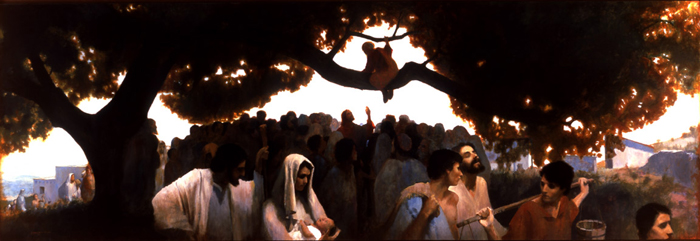
(On Zaccheus)
She’s always been the narrative crux,
her branches grown thick
as his presence in Luke, raising
his faith so he can anoint God’s head
with his sweat, her shadow pinned tight
to the Teller’s canopied bosom of words.
She’s no different here in her browns
and rusts, peering down the blouse
of my soul from the artist’s throng,
playing my gaze through the spaces
between her sprawling geography.
She frames her fruit well on that throne
of a branch where he sits mid-startle
against the plot twist, holding his perch
to keep from falling too hard
on his faith. Yet the centuries
nearest her act, the children of the children
of the child nearest the viewing pane—
see how she tilts her head toward the throng,
mouth wide; tries to suckle
from the tale—forget; even Zaccheus
moves on after Christ points him out, calls him
down, invites himself over for tea
with the publican and his family.
But Christ’s finger reaches
beyond his words, beyond pigment, beyond
the curving branch of the sycamore
he touches at last. Always
to the Garden. To the serpent. And
Eve, knowledge dripping from her lips
like juice pressed from a thousand figs
as Adam walked in from the cool of day
and she reached to fit his waist
with the apron
she’d learned to make from her Mom.
For the Sycamore
(On Zaccheus)
She’s always been the narrative crux,
her branches grown thick
as his presence in Luke, raising
his faith so he can anoint God’s head
with his sweat, her shadow pinned tight
to the Teller’s canopied bosom of words.
She’s no different here in her browns
and rusts, peering down the blouse
of my soul from the artist’s throng,
playing my gaze through the spaces
between her sprawling geography.
She frames her fruit well on that throne
of a branch where he sits mid-startle
against the plot twist, holding his perch
to keep from falling too hard
on his faith. Yet the centuries
nearest her act, the children of the children
of the child nearest the viewing pane—
see how she tilts her head toward the throng,
mouth wide; tries to suckle
from the tale—forget; even Zaccheus
moves on after Christ points him out, calls him
down, invites himself over for tea
with the publican and his family.
But Christ’s finger reaches
beyond his words, beyond pigment, beyond
the curving branch of the sycamore
he touches at last. Always
to the Garden. To the serpent. And
Eve, knowledge dripping from her lips
like juice pressed from a thousand figs
as Adam walked in from the cool of day
and she reached to fit his waist
with the apron
she’d learned to make from her Mom.
Friday, July 3, 2009
Ronald Wilcox: "Portrait of a Puritan"
 I've been reading my way through the poetry published in Dialogue for a project I'm working on (note: I absolutely love the searchable DVD archive they sent me for my recent contribution) and I discovered a long poem by Ronald Wilcox: "Quantum Gospel: A Mormon Testimony." (The link leads to the table of contents for volume 40.2 [Summer 2007]; I wish the poem was accessible elsewhere, but it's not. Sorry. The journal's got to make some dough somehow, I guess.) It explores, among other things, the connections between nature/creation/the universe, the individual, and God. One of my favorite lines from the poem is this: "My flesh is wrapped about schisms of intentions."
But enough teasing.
Because "Quantum Gospel" kind of swept me off my feet (even though I don't completely understand it---hooray for re-reading!), I thought I'd look up some of his other Dialogue published poems and found that he's also published in Harvest: Contemporary Mormon Poems (with a longer version of "Multiplicity," another striking poem I must return to). Of his other poems, I thought I'd direct you to "Portrait of a Puritan" with this post.
In this poignant short poem, the poet paints a word picture of a young man "who hangs between two [socio-cultural] poles / (approval/disapproval) / who fits or does not fit / the occasion according to conscience" (lines 2-5). In other words, he's caught between two worlds: between strict adherence to the prudish traditions and cultural mores and adherence to his conscience, which sometimes seems at crossways with his community. (Sound familiar to anyone?)
But what is he to do? Having been brought up within this distinctive cultural "cant" (or, as I read it, cultural bend), however, as the poet reminds us, "[h]is will is not his own" (7-8). He must obey or face some degree of castigation from "[h]is ubiquitous [and preponderant] parent" (9)---representative of the cultural will---who mumbles a perpetual and "inaudible [because culturally implied] no" (13) and whose finger has bookmarked "Ecclesiastes" (14), meaning the parent's life and thought is defined, in large part, by the Preacher and, thus---because how and what we think is to a great degree determined by what we read and the culture we're bound to---by a tendency to preachiness.
But again, as the poet reminds us, his "friend[s]" (15), those who, like him, have a proclivity to question, well, most if not everything: we should leave "him alone" (15). He has his cultural aches and pains, his personal will and desires buried beneath the communal facade. And his dreams are filled with images of freedom: "wind and rain and sky" and "a wild goose cry[ing] / [...] / in the naked night" (16-9). In short, we who consider ourselves more (intellectually, socially, emotionally, sexually, etc.) free should feel for him and seek to remember such tendencies in ourselves. We shouldn't judge so harshly when we see Puritans being, well, Puritan.
I think this is a good example of one way literature can affectively (yes, I mean it with an "a") show a culture something about itself by analogy and metaphor, even---and especially---without being overtly didactic.
And I leave the image at that.
Thursday, July 2, 2009
Imagine Me, A Missionary
We had the missionaries over for dinner tonight and I did some Mormon letters proselyting of my own. Since my review of Twilight for Dialogue came with three contributor's copies of the journal and since I knew one of the missionaries is somewhat the literary type (last time they were here, we talked about Orson Scott Card and some other books) and since he picked up the copy of Bright Angels and Familiars: Contemporary Mormon Stories that was left (maybe purposefully) on the kitchen counter and spent more than a few minutes looking through it, I gifted him one of my two extra copies of Dialogue and introduced him to Irreantum (Volume 9.2/10.1, which he spent some time reading). And some of our dinner talk was spent discussing literature.
It may have been a distraction, but boy, did it feel good to feign some kind of literary expertise.
It may have been a distraction, but boy, did it feel good to feign some kind of literary expertise.
Wednesday, July 1, 2009
Rua: An Elegy in Holes (Poem)
Here's another one from my "Cloudfire" sequence.
Feedcrack welcome (if you lurkers and RSS readers please).
* * * *
Rua*: An Elegy in Holes
*Māori: (noun) hole, pit, burrow, chasm, grave, store (for provisions), abyss.
Feedcrack welcome (if you lurkers and RSS readers please).
* * * *
Rua*: An Elegy in Holes
My journal propped to the day you fell around the earth, dropped to a point I can only approximate anymore with a secondhand map, some tacks, and a string to slice away the pudding skin of memory, I prop these skin-thin proofs in my aperture casement, watch you drop through my hunger by layers like when we excavated the neighbor’s sandbox, made the hole so deep we could map every sheet of clay, stand tip-toed, arms raised against the grave, voice leveled into soil, and still hide from the world, though Mom still managed to find us, conjugating our name in the breeze—she must have mapped our desire from the womb, known we’d eventually start digging holes to contain the fire licking our bones, the lust that’s propped me in the window of your first Auckland flat to watch you unpack—shirts, slacks, socks, shoes, suits, the nightly routine you’ve worn so long it’s threadbare at the knees—to air the ethereal between us with a length of mist, foreign soil, and mid-summer breeze, the line you’ll hang memories on after rain until they're dry enough to take notes on, to slide into your billfold beside NZ dollars creased in thirds, ridges grimy with the island’s fingerprints, like my camera lens, blurred by the hands of Māori kids who’ve dropped into the hole we dug and propped themselves against the walls, their fingers plugging the dike of memory to keep me from wrapping the world in spools of secondhand wind.
*Māori: (noun) hole, pit, burrow, chasm, grave, store (for provisions), abyss.
Subscribe to:
Posts (Atom)