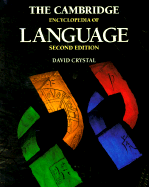
This email (title above) popped up in my inbox when I was working on that last post. Seems that, unlike Borders, Alibris knows how to seduce me. And one of the books they suggested actually looked interesting: The Cambridge Encyclopedia of Language by Professor David Crystal, "a stimulating and richly illustrated guide to the variety, structure, history and theory of language. David Crystal not only conveys the intrinsic fascination of the subject, but also its enormous complexity."
Stimulating. Richly illustrated. A subject of intrinsic fascination and enormous complexity.
Our youth speaker today discussed agency. She talked about the standard stuff---us being free to choose and all. I must confess that I was distracted by daughters number two and three through most of her talk, so I didn't catch everything. (Shame on me, I know.) Until she read 2 Nephi 2: 27---pretty standard fare, but with a difference. Here's how she read it:
Wherefore, men are free according to the flesh; and all things are given them which are expedient unto man. And they are free to choose liberty and eternal life, through the great Meditator of all men, or to choose captivity and death, according to the captivity and power of the devil; for he seeketh that all men might be miserable like unto himself.
The extra letter perked up my ears enough that I started thinking (surprise!) about the power of words, about how one little letter---in this case, an errant 't'---can make such a grand difference in the meaning of a word: Mediator vs. Meditator. One who goes between vs. one who meditates, ponders, thinks deeply on important things. And Christ, it seems, is both. He steps between us and the demands of justice, freeing us from the captivity and power of the devil, but only as we allow his influence---through the power of agency---into our lives. And he ponders long and deeply on matters of eternal import (including how best to meet our needs), a characteristic, I think, that's part and parcel of Godhood, of his ever-increasing knowledge and dominion.
And thinking about the power of this letter now has me thinking about how God can use our slip-ups, our weaknesses, our mistakes, our human fallibility---even how he can work through us in spite of these things---to make a difference in others' lives, like this youth speaker did for me today, completely unbeknown to her. In fact, I'm certain she, along with many others in the audience, didn't even realize the alphabetical addition.
But I've been meditating on it since. Chalk it up to a growing sensitivity for what my and others' language is doing or to my general obsessive-compulsiveness when it comes to matters of language (e.g. spelling, grammar, usage) or to the fact that I just think way too much. But that errant 't' struck me in an unexpected way.
Here's to hoping this errant 't' can do the same for you.
We've been trying to get number two toilet-trained for, um, I don't know how long---a while now---and just when we think she's in the rhythm, the record skips and we have to start the song over and over and over again. Yet, serendipitously, we ran out of pull-ups the other day and I put one one of number three's diapers on her. Apparently such diapers are not the in-thing for three-year olds this summer, because she took it off and opted for panties instead.
And she hasn't had a daytime waste incident (meaning away from the pot) in the few days since.
What was it Juliet said? Not nomenclature of rose or Romeo. Not to Lawrence about lurking beneath serpents’ skin or lying with dead men’s bones. Not to the vial about this conceit of death and night,
receptacle of flesh and memory. But in the tomb, after she’d bent to plant one on her husband’s corpse, to divert his rigor into the troubled pool of her flesh. As she thrust his knife through the adolescent bloom
of her breast—This is thy sheath. Thy vessel. A peephole through my skin into the serpent’s mouth. Come see how it’s used your rib to pick our future from its teeth, how its venom floods the amniotic sac of my soul. Come
see me in this woman whose rose hangs like a bloodstain over her bosom, stem slinking down her navel and between closed legs like my blood pooled and snaked as I fell at last against your hardening flesh. Come see
how our tragedy broods over this purgatorial plain spread thick with the lamentation and promise of apocalypse, how the bodies, old garments shed, forever rise toward some slit in her tendriled mane,
how they twist to face the mystery beyond the vaginal threshold, how the trio in the top left quarter hangs near enough rebirth to blossom into longing beyond the artist’s red stain.
On my run this morning, I was considering dissertation directions. Here are a few I've been mulling over (in no particular order):
1) An Ethics of Textual Intimacy: Latter-day Saint Narratives of Embodiment
This one feeds my growing interest in ethics and literature (i.e. how does this narrative influence me? how do my values influence my reading of this narrative? how does "listening" to this narrative effect my immediate---and beyond---quality of life?), my continued engagement with the rhetoric of embodiment (i.e. what is the connection between body, mind, and language?), and my commitment to studying Mormon culture and cultural artifacts.
2) In Constant Paradox: Personal/Critical/Narrative
This one plays into my frustration over the pedantry and pretension of academic literary studies (in which writing about and from personal experience is, well, frowned upon) and deals with the notion of personal/narrative scholarship, i.e. critical scholarship in the form (as it were) of the personal essay. "In constant paradox" refers to the ever ambiguous situation of the scholar, who stands at the intersection of these personal, critical, academic, narrative worlds.
3) An approach to the life, work, and legacy of Eugene England
This one engages my interest in Mormon studies and one of its founding fathers in a way that focuses on England's theoretical approach to Mormon culture and his contributions to the Mormon intellectual legacy.
4) Joseph Smith's Literary Genius
This one approaches Joseph Smith as a literary mind (well, duh! I got that from the title, you say) who built the foundation for an expansive Mormon literary tradition.
Right now I'm leaning toward 1) because it seems the most refined and well-defined, but I vacillate so much on these things, I may well end up focusing on one of the other three, or something completely different.
But at least I've got options to consider and time to get the work done. I've just finished my first year of coursework and still have one more to go before the "official" dissertationing begins, though that doesn't mean I can't get the jump on things.
So Borders asks in the most recent email I got begging me to come back, to buy some books from them. And I rejoinder, "What the heck kind of marketing technique is that? Of course I like books. And, sure I used one of your outlet stores to feed my bibliophila, but I didn't think we were exclusive. I'm playing the field right now and I think I always will. So get off my back. You're suffocating me."
Couldn't they think of something a bit less, um, manipulative?
Two posts, you say? In one day? What's the deal, man?
Well, it must be the day for confessing new love because I can't hold this in anymore and I'm going to scream it from the rooftops! Er, at least from my diminutive corner of Planet Blog.
Anyway. Here it is.
I'm hooked on the new series The Book of Jer3miah, a self-consciously and unequivocally Mormon conspiracy-thriller produced by some BYU students and their professor, Jeff Parkin, and distributed via the Web (on the show's website and, of course, on YouTube; see the trailer below and then check out the show for yourself).
The thing that interests me most about the show (and I'm considering doing a longer write-up for AMV sometime in the near future---maybe) is how it positions itself firmly between ultra-orthodox Mormon art (as in the kitsch offered by Deseret Book and Friends) and non-orthodox Mormon art, between "right-wing and left-wing piety and cultural[/political] correctness and mutual exclusion." It is part of the "radical middle," as Eugene England phrased things in terms of "parties" in the Mormon arts and letters camp. It attempts to negotiate the way towards a more honest, a more spiritually real depiction of Mormonism in art. And I define "spiritual realism" thus (as I first mention here): "The province of such spiritually real [art and] literature, as Lavina Fielding Anderson has it, isn’t so much to capture and embrace the ephemeral nature of spiritual knowledge---though that does seem to be part of the exercise of 'spiritual realism'---but to be an act of literary faith, an 'intelligent affirmation' of and engagement with the moral universe."
The whole supernatural/conspiracy theory thing juxtaposed with religious stuff just doesn’t do it for me. I’m all about supernatural sci-fi-esque shows. But the reason I can watch them is because of the whole “suspension of disbelief” thing. When people cram a bunch of references to a religion that I believe it, and to things that I believe are true above all else, I can’t suspend disbelief enough to watch the show and enjoy it. So I get all nitpicky about the details.
My wife, who watched the last two episodes with me last night (they're all very short---between 3 and 9 minutes each, most about 5 minutes long or so---and I watched all 20 of them yesterday), responded with a similar sentiment. She said something like, "Too bad God doesn't do those things today." Meaning tell young men to kill people when the situation (arguably) requires it (a la the Nephi/Laban experience). Meaning transport people out of danger (a la Alma and Amulek, the Three Nephites, etc.). Meaning call people to take care of mysterious boxes/materials that contain great redemptive power (a la Lehi and Nephi and Joseph Smith, etc.). And I find myself asking the question, Why is it so hard for us, meaning Mormons in general, to suspend disbelief enough to think that God could do those things today, if circumstances warranted?
Do we take ourselves and our culture too seriously?
And I think that's one point of the show (which I'm calling a dialed-down, Mormon suspense akin to Lost): to explore the notion that God could do just those things, even today. If we believe, as Mormon taught, that God is a God of miracles and that, even today, he has not ceased to be God, why not explore the possibility that the miracles repeated anciently (and even, in the case of Joseph Smith, just a relatively short time ago) could happen in our own lives, even in Happy Valley, Utah (a la Singles Ward and Pride and Prejudice and friends)?
I believe they could happen. And that, for all intents and purposes, The Book of Jer3miah is one of them.
I, for one, hope it succeeds. And that it opens doors to more projects of the same radical middle moral caliber.
Thanks to The Fob Bible (Plain and Precious excerpts here), I've been introduced to the work of Danny Nelson, a talented poet who works equally well (from what I've seen, anyway) in light verse (as here, here, here, here, here, and here), the free verse dramatic monologue (here), and forms situated between (here, here, and here). One of my favorites is his dramatic monologue, "Jacob, to Esau," mostly because of how it offers a different perspective on the relationship between these OT brothers, but also because it's a poignant reminder that family bonds stick with us, even after we've had a falling out. I especially like the moment of realization Jacob (through the poet) offers in the final four lines. But I won't repeat them here; you'll have to go look for yourself.
You can find more on The Fob Biblehere (and stay tuned, because I've still got half a review to post there next week).
I knew when I started thinking of experiences as "posts" that it was time [to start blogging].
--My Oldest Sister
So Luisa's post from yesterday pushed me over the top. I've been thinking for the past few weeks, if a bit longer, about why I blog. After I finished posting everyday in April for National Poetry Month, I fizzled into blogger burn-out and my fire's only smoldering anymore. I've stopped thinking of reasons to post---scratch that; I think of things that might make cool posts but never give them life; even now, I'm wondering why I'm writing this because I just feel like I'm whining---and I sometimes find it more a chore to keep house here than anything, especially when I get so few comments that I feel like I'm talking to myself.
And I can do that without Blogger looking over my shoulder.
I do feel less of a need for feedcrack (Luisa's word for "comments, input, interactive readership") than I once did, but I still feel like I'm yearning for the validation of the inhabitants of Planet Blog.
How pathetic is that? (Go ahead. Do it. Extend the pointer finger and thumb on your right hand, put the 'L' to your forehead, and point in my direction. That's it.)
The two bright spots in my blogging commitment have been my decision to keep on with my Mormon Poetry Project, through which I've found some great poets and poems that inspire me in my second area of light---posting poems in progress, which Theric is almost always kind enough to comment on. (And both of these are likely to play a defining role in the continuing development of my blogging identity.)
I do follow a short list of blogs in my reader (most of which you'll find in the aggregator to your left), to which I add one or two every once in a while. I'm more a quality over quantity guy, so to make it onto my list means something, though I'm not quite sure what that might be---probably that I've come to consider you a friend or you're part of my family or in line with my engagement with poetry and Mormon Letters.
And this network, I think, is one other reason I'm still here (whether for good or for ill, you be the judge). I have no blogcrushes, save, perhaps, with A Motley Vision, which is really the center of my blogging community and one reason I took on some Blogger property myself.
And so, in response to Luisa I say, No, you're not alone in your constant pursuit of community (and maybe a bit of validation). And though I've just been introduced to your blog, I'm responding to you here and adding you to my reader because I see in you someone a bit like me, except that I'm not female and really know very little about you---but your struggles seem to be my struggles.
And for now, that's good enough for me. (Not to mention that William at AMV gave you the nod. And I, almost, trust him implicitly.)
In the opening section of T.S. Eliot's Four Quartets, “Burnt Norton,” the poet muses on the interconnections and “unredeemab[ility]” of time (line 5): “What might have been,” he says, “is an abstraction / Remaining a perpetual possibility / Only in the world of speculation” (6-8), the business of imagination and memory. He opens the door to this possibility when he hears
Footfalls echo in the memory Down the passage which we did not take Towards the door we never opened Into the rose garden. My words echo Thus, in your mind. (11-5)
The poet’s job, then, this implies, is to pursue the footfalls of memory into places we’ve never been. “But to what purpose,” he asks, does “[d]isturbing the dust on a[n imagined] bowl of rose-leaves” serve (16-7)? Why pursue these “echoes / [that i]nhabit the garden[?] Shall we [indeed] follow” them “through the […] gate” of meaning; “[i]nto our first world, shall we follow / The deception of the thrush?” (17-8, 20-2). And yet the voyage into and through deception, he suggests, is the end “which is always present” (48). So perhaps, though the past is ultimately “unredeemable,” we can redeem ourselves, our identities, as the poet's efforts suggest, in the myriad possible passageways of and rhetorical passages written by memory.
Emma Lou Thayne takes this poetic cue in "The Rose Jar" wherein she quite literally (if we can take her at her word) disturbs the dust in her grandma's jar of rose petals, stirring up the fragrance of rose and memory as she runs her fingers and her mind over the intricate surface of the "four inch cloisonne [jar] on pointed golden legs / fat as a Buddha tummy" (lines 9-10). Finding this jar in the "cedar drawer" of her "Grandma's standing metal trunk" (1-2), she enters the intersection of several memories, some her own, some others'. The cedar musk reminds her of "some Arabian tale read by Father / in the hall between bedrooms to say goodnight" (5-6); the rose petals call forth "five generations of fragile crinkles" in lives "once supple, fresh," but now only "fragile" memories (7-8); the jar itself inspires visions of "centuries of Chinese hav[ing] their way" in an intricate culture, their "careful hands [...] pluck[ing] each [intricate] piece in place" (18-9); and the fragrance of it all, of this "holy mash," becomes "tiny gusts / of history waft[ing]" community rituals---"the gatherings of births, graduations, / weddings, funerals, celebrations"---"into decades collecting / but never filling [the jar] to the top," instead infusing the space of life, of memory with the "subtle, still surprising breath of God" (20-7).
And that, I think, is one reason we disturb the dust on a bowl of rose-leaves: because doing so draws us together in bonds of imagination, kinship, and shared memory, such that, like Adam and Eve, we are infused with the breath of God and so become living souls, living communities.
And that, I think, is one thing poets and poetry are for.
Here's another one from Cloudfire and a Bowl of Kauri Leaves. You may leave feedback if you wish. I'll allow it...
* * * *
Te Kore
Haere mai: I’ve anticipated your soul-deep craw. Stewed pork bones and potatoes to tender verging on cream. Sent the kids, brown bodies sliding between the breeze, to gather more puha from the fenceline. Sonchus oleraceus: slides from the tongue into the boil just long enough to soften the cellulose, give the broth enough bite to open the palate, throw windows wide on sense. To bathe you in steam thick as the threshold we cross between words.
E noho: I see hunger squirm beneath your skin. Break bread. Dip it in butter heavy as afterbirth. Let the excess glide across your tongue, drop into the well of appetite, filled with milk fresh from the coupled Void. Sidle toward the breast. Press between her skin and his. Join the sextuplet gods waiting to suckle, mouths wide against emptiness, hunger sliding between lips chapped from too long in the womb—
ora mate ora mate ora Ply your flesh in this orgy of mythologies. Mix spittle with the grammar of desire shorn from Adam’s side. Slip on this red clay like spirit slips on nakedness. An infant its mother’s breast. Meaning, the itch always just out of reach. Slide from this amniotic tide into the metaphor christened body. Meaning movement. Meaning legion. Meaning drink from this cup and we’ll help you forget to
Note: I've decided to carry on with my Mormon Poetry Project, though it'll be a once a week venture from here on out. While April's everyday posting was fun, it burned me out. So I think once a week will be a happy medium and it'll keep me invested in my interest in Mormon poetry.
* * * *
I've had Eugene England on my mind a bit lately and thought it would be fitting turn over this new poetry leaf with one of his poems that was published in Dialogue shortly after he passed on: "Two Trains and a Dream." While it's not a striking poetic achievement, it does capture what is, for me, the central concern of his life and work: the paradoxical complexities of God's relationship with his children and the dialogue the faithful enter into with God as they rove through his creations with an insatiable curiosity.
With a style that's a far cry from his formalist training---the lines are loose and long and prose-like, such that the poem almost reads as a micro-essay (the essay being England's true writerly calling, I believe)---he explores the apparent arbitrariness of God's decisions to save some from danger (as Joseph F. Smith from a train accident) and to allow others to die (as a mother and her children all killed by a train). Then, in his relation of a dream, he shows us the weeping God of Mormonism, an intimate, compassionate God who sits so near his children, who listens to them so intently that he weeps over their pain, over the hand of his justice as it holds all of us in its inescapable grasp, to the blessing of some, the cursing of others.
And so he shows us the intimate connection between God's justice and mercy, the interaction of which pulls blood from every one of his deep pores, blood which, in turn, washes those who come to him with their questions, their struggles, their wonder, into his presence, into his eternal likeness. But only as we truly learn to come to him, to see him as he is. Such is the quest of mortality. Such was the quest, I believe, of Eugene England's life and work.
Daughter #1 finished Kindergarten today. And for some reason, though I've been out of school for nearly a month, now I feel like my summer can really begin. It's like I've been waiting for her to be done to get the whole feeling of summer liberation.
Either that or it's taken me this long to decompress.
So, on with the show.
Let the games begin.
Ready. Set. Go.
I'm off to enjoy my family's summer and my summer projects/goals (yes, I really do have some things in mind).
Last night we ate Chinese in search of better fortunes. We got something about an airplane, something about obstacles (like we need more of those), something about fun. Here's what I pulled out of my on-the-verge-of-stale cookie shell:
"Use your abilities at this time to stay focused on your goal. You will succeed."
Now if I only had some goals to focus on, I could taste the sweet nectar of success. (It is sweet, isn't it?)
Until then, I'll just stagnate in the shallows of undefined, unwritten, unwieldy ambition. Join me for a drink?
 This email (title above) popped up in my inbox when I was working on that last post. Seems that, unlike Borders, Alibris knows how to seduce me. And one of the books they suggested actually looked interesting: The Cambridge Encyclopedia of Language by Professor David Crystal, "a stimulating and richly illustrated guide to the variety, structure, history and theory of language. David Crystal not only conveys the intrinsic fascination of the subject, but also its enormous complexity."


